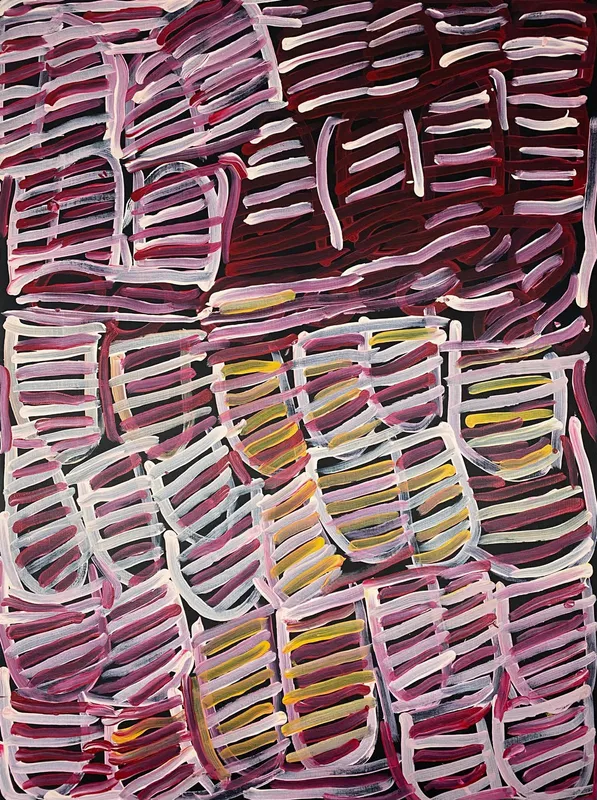
Lines of Country brings together the work of Minnie Pwerle alongside that of four influential First Nations women artists: Jorna Nelson Naparulla, Kayi Kayi Nampitjimpa, Makinti Napanangka and Maggie Watson Napangardi. Each artist translates deep cultural knowledge, ceremonial traditions and connections to Country into distinctive visual languages.
This online exhibition centers on the work and legacy of Minnie Pwerle, one of the most celebrated painters to emerge from the Utopia region of Central Australia, and places her practice in dialogue with four influential contemporaries: Jorna Nelson Naparulla, Kayi Kayi Nampitjimpa, Makinti Napanangka and Maggie Watson Napangardi. Through their distinct yet interconnected artistic languages, these artists reflect the strength, continuity and evolution of First Nations women’s painting traditions across the Central and Western Desert regions.
Born in the Atnwengerrp community in the Utopia region of the Northern Territory, Minnie Pwerle belonged to the Anmatyerre and Alyawarr language groups. Although she began painting relatively late in life, around 1999, her work quickly gained recognition for its striking energy and fluid movement. Her paintings translate the ceremonial body markings of Awelye, women’s ceremonial practices connected to Country, kinship and ancestral law, into bold, sweeping compositions. Through rhythmic lines and vibrant colour, Minnie conveyed stories connected to bush tomato, bush melon and other Dreaming narratives associated with her Country. Her paintings are celebrated for their immediacy and vitality, expressing both personal authority and collective cultural knowledge.
The influence of Minnie Pwerle extended beyond her own practice. Encouraged in part by her daughter, the prominent artist Barbara Weir, painting became an important activity within her family. Her sisters, Gayla Pwerle, Emily Pwerleand Molly Pwerle, later joined her, forming what became known as the Four Pwerle Sisters. Working together on shared canvases, they developed a collaborative approach that echoed the communal nature of ceremony and storytelling in their culture. Their works, often painted while seated together around the canvas, combined individual gestures into unified compositions built from layered dots, flowing lines and symbolic references to women’s Dreaming stories.
While the collaborative paintings of the Pwerle Sisters form an important aspect of this exhibition, Minnie Pwerle’s work also resonates strongly with that of her contemporaries represented here. Like Minnie, artists such as Jorna Nelson Naparulla, Kayi Kayi Nampitjimpa, Makinti Napanangka and Maggie Watson Napangardi translate ancestral knowledge, ceremonial practice and deep connections to Country into powerful visual forms.
Although each artist developed a distinctive style, their works share underlying cultural foundations. Makinti Napanangka’s dynamic brushwork and vibrant colour fields evoke the movement of ceremonial life and the landscape of her Country, while Jorna Nelson Naparulla and Kayi Kayi Nampitjimpa employ intricate patterns and iconographic systems to map Dreaming narratives and sacred sites. Maggie Watson Napangardi’s compositions likewise reflect the rhythms and structures of ancestral stories embedded in the land.
Together, these artists demonstrate the diversity of contemporary Aboriginal painting while affirming its shared cultural roots. Through their works, ceremonial knowledge, women’s stories and the enduring relationships between people and Country are carried forward into new visual expressions. At the heart of this dialogue stands Minnie Pwerle, an artist whose bold, intuitive paintings continue to resonate across generations and across the wider field of First Nations art.